Eight monkeys got their second chance. For some of them, that second chance has been almost three years in the making.
On September 17th, the eight monkeys were moved to La Ceiba, our primary release station located within a primary forest that forms part of an important biological corridor. Deep in the forest, they were placed in a large enclosure where they could begin adapting to their new surroundings: the sounds of the forest, the smells, the weather, the movement of the trees, and everything else that comes with life in the wild.
A few days later, on September 22nd, it was time to open the door.
Some immediately headed into the canopy. Others took a little more time to decide where to go. But by the end, all eight were out in the trees.
This moment may look simple, but getting here can take years.
Rehabilitation starts from the very beginning
When a monkey arrives at Jaguar Rescue Center, its rehabilitation journey depends on its age, health, and individual needs.
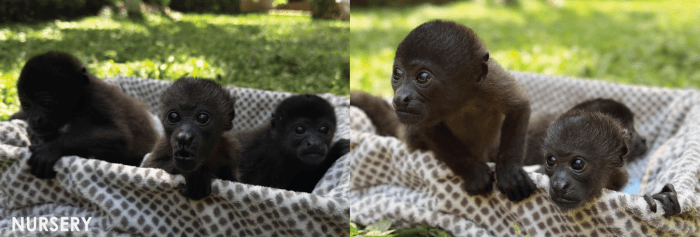
For very young babies, the first stop is the nursery. At this stage, they are still too small to explore independently and spend much of their time sleeping and growing. Their diet is primarily milk, prepared with a special formula by our team to provide the nutrition they need during these first stages of life.
As they become stronger and more independent, they move to the Monkey Preschool.
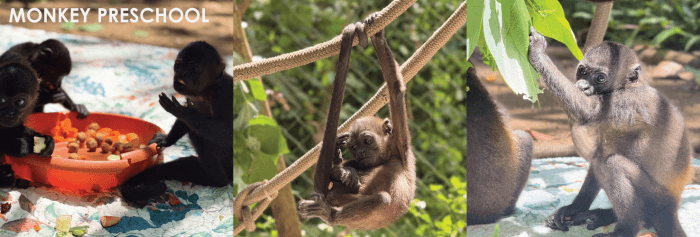
Here, the young monkeys begin to explore their surroundings and develop some of the skills they will eventually need in the forest. The enclosure includes small trees, ropes, and structures that mimic the vines and branches they will encounter in their natural habitat. This is also an important stage for their social development. Monkeys are highly social animals, and learning how to interact with others is an essential part of rehabilitation.
Throughout this process, they have a surrogate mother with them. Her role is to monitor their behavior, keep an eye on their interactions, and make sure they remain safe while they learn and grow.
Their diet also changes as they develop. Instead of relying mainly on milk, they begin eating a diet based on fruits and leaves, helping them gradually adapt to the foods they will encounter in the wild.
Learning to be independent
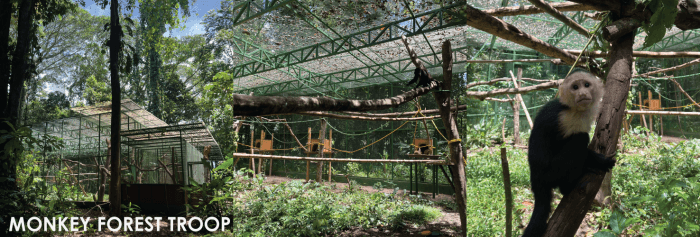
The next step is the Monkey Forest Troop, the final stage of rehabilitation before release.
This larger space gives the monkeys more opportunities to practice the skills they will need to survive independently. They can move through a more complex environment, interact with other monkeys, climb, explore, and make choices for themselves, while our team continues to monitor their progress.
Before reaching this stage, monkeys also spend time in large rehabilitation enclosures with as little human interaction as possible. This is an important part of the process. Rehabilitation is not about making wild animals comfortable around people. It is about giving them the space and time to become wild again.
The goal is for them to develop the physical abilities, social behaviors, confidence, and independence they need before returning to the forest.
For some monkeys, this entire process can take up to three years. The timeline is never exactly the same. It depends on each animal's
health, development, behavior, and how quickly they acquire the skills they need to live independently.
The final step: La Ceiba
Once the monkeys are ready, they are transported to La Ceiba, our primary release station located in a primary forest.
There, they enter another enclosure, this time deep in the jungle.
This stage gives them the opportunity to experience their future home before they are fully released. They can hear the forest around them, feel changes in weather, smell the vegetation, and observe the trees and other wildlife that will become part of their new environment. After several days of adaptation, the enclosure door is opened.
This is called a soft release.
The door remains open, allowing the monkeys to leave and explore the forest at their own pace. They are not forced to leave immediately, and the enclosure remains available as a safe place they can return to while they become familiar with their surroundings.
But opening the door does not mean our work ends.
During the first days after release, a member of our team returns to the area to check whether the monkeys are nearby or have returned to the enclosure. We also use camera traps to monitor their movements, including during the night, without disturbing them.
Every release is a step into the unknown, but the years of preparation give these animals the best opportunity to make that step successfully.
Almost three years for a moment of freedom
For the eight monkeys released this week, the moment they climbed into the trees was the result of a long journey.
From the nursery, to Monkey Preschool, to the Monkey Forest Troop, and finally to the forest itself, every stage has a purpose.
Since Jaguar Rescue Center opened its doors in 2008, we have rescued more than 770 monkeys. Some arrive as tiny orphans that need around-the-clock care. Others arrive injured or unable to survive on their own.
Whatever their starting point, our goal remains the same: to give them the opportunity to return to the wild whenever it is possible.